
Holy Week and Easter are the central events in the Christian calendar. They remember the final days of the life of Jesus Christ, his death, and his resurrection. For Christians, these events are the foundation of our faith because they are understood as the moment when God acted to forgive sin and restore humanity.
Holy Week
Holy Week is the week leading up to Easter. It is called “holy” because it commemorates the most significant events of Jesus’ life and mission. Christians often observe this week with special church services, Scripture readings, and times of reflection.
Holy Week begins with Palm Sunday. This day remembers Jesus’ entry into the city of Jerusalem shortly before his death. Jesus rode into the city on a donkey while crowds welcomed him by waving palm branches and laying them on the road. They praised him as a king sent by God. However, the excitement of that day contrasts with what soon followed.
During the early part of the week, Jesus taught in Jerusalem and confronted various religious leaders who opposed him. Christians remember this time as a period when Jesus warned people about hypocrisy and called them to repentance and faith in God.
Later in the week comes Maundy Thursday. The word “Maundy” comes from a Latin word meaning “command,” referring to the command of Jesus to celebrate the meal of the Last Supper. The Last Supper was the final meal Jesus shared with his disciples before his arrest. During this meal Jesus instituted the what the Bible later calls the “Lord’s Supper” (also called Holy Communion). Jesus took bread and gave it to his disciples saying, “This is my body,” and he gave them wine saying, “This is my blood.” In this meal Jesus gives his true body and blood together with the bread and wine (the Real Presence). This isn’t something that can be scientifically explained (as no miracle can), it’s accepted by faith. The gift of Holy Communion was given “for the forgiveness of sins.” Jesus also told his followers to continue this meal in remembrance of him. Christians have celebrated the Lord’s Supper in their worship ever since.
That same night Jesus went to a garden called Gethsemane to pray. There he was arrested by soldiers after being betrayed by one of his disciples, Judas Iscariot. Jesus was taken to trial before Jewish and Roman authorities.
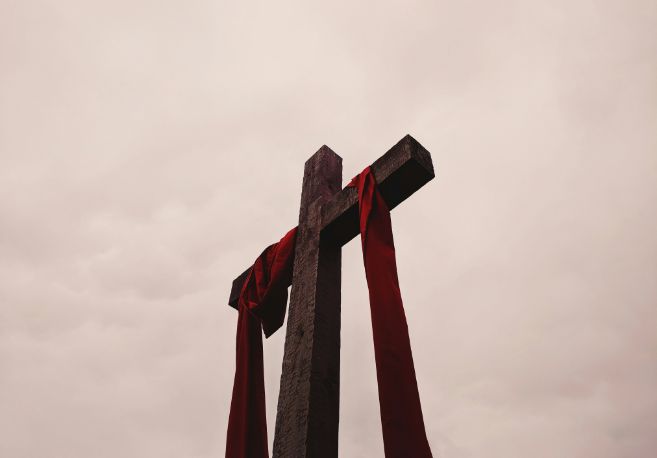
The most solemn day of Holy Week is Good Friday. On this day Christians remember the crucifixion of Jesus. After being condemned by the Roman governor Pontius Pilate, Jesus was executed by crucifixion, a common Roman method of capital punishment. From a historical perspective, this was the death of a man considered troublesome by authorities. From a Christian perspective, however, it has a much deeper meaning.
Jesus willingly suffered and died to take upon himself the sin of the world. In other words, his death is understood as a sacrifice that brings forgiveness and reconciliation between God and humanity. Because of that meaning, the day is called “Good,” even though it remembers a tragic event.
The following day, Holy Saturday, is traditionally a quiet day of waiting. According to the Gospel accounts, Jesus’ body lay in a tomb while his followers mourned and feared what might happen next.
Easter
The week reaches its climax on Easter. Easter celebrates the resurrection of Jesus—that after dying and being buried, he physically rose from the dead on the third day.
Several women who were follower of Jesus went to his tomb early on Sunday morning and found the stone rolled away and the tomb empty. They were told by angels that Jesus had risen. Later, the Gospels describe Jesus appearing alive to his disciples and hundreds of other followers.
For Christians, the resurrection is the most important event in their faith. It is seen as God’s confirmation that Jesus truly is the Son of God and that his death accomplished what he promised: forgiveness of sins and victory over death.
Because of this, Easter is not only a remembrance of something that happened in the past. Christians believe it has ongoing meaning. The resurrection is understood as proof that death does not have the final word, and that those who trust in Christ will also share in eternal life.
Churches often celebrate Easter with joyful worship services that emphasize hope and new life. The mood is very different from the solemn tone of Good Friday. Music, decorations, and sermons all focus on the victory of life over death.
Many cultural traditions are also associated with Easter, such as rabbits, eggs, and springtime imagery. These customs symbolize new life and renewal, themes that fit naturally with the message of resurrection. However, these traditions are secondary to the central Christian message of Jesus rising from the dead.
The Meaning of the Season
Taken together, Holy Week and Easter tell a single story. Holy Week recounts the suffering and death of Jesus, while Easter proclaims his resurrection. For Christians, these events reveal both the seriousness of human sin and the depth of God’s love.
The message at the heart of the season is that through the death and resurrection of Jesus Christ, forgiveness and new life are offered to the world. Because of this, Easter is the most important celebration in Christianity—more central even than Christmas—because it marks the victory that stands at the center of the Christian faith. As St. Paul wrote,
“If Christ is our hope in this life only, we deserve more pity than any other people. But now Christ has come back from the dead. He is the most important of those who have died to come back to life. Since a man [Adam] brought death, a man also brought life back from death. As everyone dies because of the sin of Adam, so also everyone will be made alive because of the righteousness of Christ.”
1st Corinthians 15:19–22